Showing posts with label Museum. Show all posts

Sunday, March 30, 2014

A Day of Reliving Prehistoric Cultures and Civilization

March 29, 2013, one fine Saturday, no plans on going out of town or whatsoever as it was spared exploring The Manila Museum’s exhibit. Luckily, i bumped into one online deal and got a whole day pass at a promo rate.

I don’t have any idea where the Manila Museum is located and when I checked Google maps, it just pointed me to CCP complex and a bit near Star City.  The Manila Museum is actually located inside Boom na Boom Park, at the back of Wensha Spa. It’s my first time to explore this part but thanks to powerful maps, i was able to arrive here safe and sound. It’s past 3 in the afternoon when I entered the museum. I have the impression they closes at 4:00 PM, that’s what the personnel stated when I called in earlier but when I got there, it actually closes at 5 PM. So I got one more extra hour to enjoy the place.

IMG_0698

I am fond of Ancient Greek an Egyptian culture since I learned about God’s and Goddesses, Trojan wars and of course the famous structures. In Egypt, I have been fascinated by the powerful Cleopatra and the Pyramids. Ancient Chinese Civilization is just a plus to what I already know. 

Stepping back from modern scene and learning ancient civilizations, arts and inventions, this is my how I will be spending my Saturday. This is perfect for all history enthusiasts as it features and replicates famous historical artifacts. I am excited to discover Greeks’ gods and goddess such as Zeus (sky), Poseidon (sea), or Venus (love) and know them more as well as the other Greeks legacies at the museum.

Though known for her lavish lifestyle and stunning beauty, Cleopatra is not enough representation of early Egypt. This country boasts wonders such as pyramids, Great Sphinx, and 4 Colossi of Ramses II. Speaking of ancient civilization, China has numerous legacies like their famous Forbidden City, Great Wall, abacus, porcelain and dynasties. These are some of the things I am thrilled to see.

IMG_0690

 IMG_0692


Please click on the  link below to learn more about the things I rediscovered from each places:

FASCINATING EGYPTIAN CULTURE AND LEGACY

CHINA’S TREASURE AND CONTRIBUTION TO THE MODERN WORLD

GREECE’S GREAT STORIES AND ARTIFACTS


Experiencing an exciting way to learn early history in a day is simply remarkable. Oh yeah, and there’s an additional memorabilia. I get to dress up as an Empress (China) and Cleopatra for a Photo Op. Sadly, there’s no costume for Greek Goddess.

DSC_1249   

DSC_1254 (2) - Copy

For information about ongoing exhibits, you may visit The Manila Museum’s Website

BuzzNet Tags:

Recognizing China’s Treasures and Contribution to the Modern World

Speaking of ancient civilization, China has numerous legacies like their famous Forbidden City, Great Wall, abacus, porcelain and dynasties. Here are some of them:

IMG_0661

SANXINGDUI BRONZE HEAD

Believed to be used in ancient ceremonies that dates back 12th century BCE, this bronze head were found in a place called Sangxidui, a buried place assumed to be an ancient Chinese City now known as Suchuan, China

 IMG_0663

TERRACOTA SCULPTURE

This is a sculpture that is dried in the sun after being formed then it was placed in the ashes of open hearths to harden. IT was classed as a ceramic material after being fired to high temperature

 IMG_0665

ABACUS

These are bamboo frames with beads sliding on wires. It is a calculating tool used primarily in many parts of Asia, especially in China. The abacus was in use centuries before the adoption of the written modern numeral system and is still widely used by merchants, traders and clerks elsewhere

 IMG_0667

GUAN GONG

He is one of the famous Chinese generals during the late Eastern Han Dynasty and Three Kingdoms era of China (206 BC – 220 BC). He was always carrying one Guan Dao sword. He played significant role of establishing the Kingdom of Shu. He is respected as the epitome of loyalty, moral qualities and righteousness. Guan Gong is being worshipped by Chinese people from the time of his death until today

 IMG_0669

 ANCIENT CHINESE SWORD

The king of weapon in ancient China, not only was this sword used for a very long time, it was also one of the greatest masterpieces of Chinese craftsmanship. This was used by the cavalry and the infantry, irrespective of the functions that the regiment performed


IMG_0671

BRONZE DING VESSEL

It is an ancient Chinese vessel shape, a large metal pot with legs a lid and two facing handles. These were used for cooking, storage and preparation for ritual offerings to ancestors. Production can be traced back as early as the 18th century BCE

 IMG_0673

ANCIENT CHINA BRONZE ELEPHANT CARVING CAULDRON RELIC

This was used as a cooking artifact, it was made during middle late Zhou Dynasty 850 BCE. This Ancient Chinese relic is 12 cm high and 11 cm in diameter

 IMG_0675

CHINESE PORCELAIN

These are plates, bowls, jars made of ceramics produced by heating materials like clay in the form of Kaolin, a mixture of clay minerals and chemical compositions formulated by the Chinese since 1,600 BCE. As early as the Ming Dynasty (1368-1644), porcelain was already being exported to different parts of the world

 IMG_0677

GLAZED POTTERY VESSEL

Pottery is made by forming a clay body into objects of a required shape and heating them to high temperatures that changes their share. Glaze is a glassy coating on pottery, the primary purposes of which are decoration and protections. Glazing potteries in China started as early as the 600 CE

IMG_0683

TERRACOTTA WARRIOR

A collection of Terracotta Sculptures depicting the armies of Qin Shi Huang, the first emperor of China. It is a form of funerary art buried with the emperor in 210-209 BCE and whose purpose was to protect the emperor in his afterlife. The figures were discovered in 1974 by local farmers in Shaanxi Province.  Current estimates were over 8,000 soldiers majority of which are still buried in the pits near Gin Shi Huangs’s Mausoleum. Terracota is made of clay ceramics


IMG_0685

CHINESE TEMPLE

A Chinese temple is a worship place of the Chinese folk religion/Shenism, where people revere ethnic Chinese gods and ancestors.


IMG_0687

CHINA RICKSHAW

It is a light, two-wheeled cart consisting of a door-less, chair-like body, mounted on springs with a collapsible hood and two shafts; it was drawn by a single rickshaw runner. Although believed to have originated in Japan, it became a very popular transportation in China. It was first seen in 1886 and was used for public transportation. Rickshaw transportation was an important element in urban development in 20th century China, as a mode of transportation, source of employment and facilitation of migration for workers

IMG_0696

THE GREAT WALL OF CHINA


It is a series of fortifications made of stone, brick, tamped earth, wood, and other materials, generally built along an east-to-west line across the historical northern borders of China in part to protect the Chinese Empire or its prototypical states against intrusions by various nomadic groups or military incursions by various warlike people or forces

Despite its being one of the four greatest ancient civilizations, the Chinese had a slower progress than any other. They have made countless contributions to the world including paper money, porcelain, noodles and other things that are part of our lives today. There were also many great works of architecture,such as,  The Great Wall of China.

Chinese is the only of the four greatest ancient civilizations that managed to survive and have lasted into modern times. The present-day China is the continuation of that evolution. We, as Filipino’s have been greatly influenced by China and even embracing their cultures and traditions.

Satisfying Curiosity on Greece’s Great Stories and Artifacts

The art of ancient Greece has exercised an enormous influence on the culture of many countries from ancient times until the present, particularly in the areas of sculpture and architecture. Greek life was dominated by religion and so it is not surprising that the temples of ancient Greece were the biggest and most beautiful.They also had a political purpose as they were often built to celebrate civic power and pride, or offer thanksgiving to the patron deity of a city for success in war.
IMG_0642

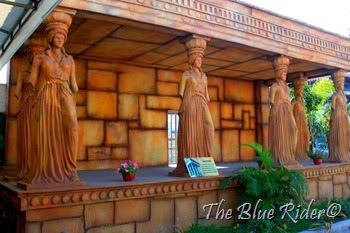
ERECHTEION

It is an ancient Greek Temple on the north side of a Acropolis of Athens in Greece which was dedicated to both Athena and Poseidon. The caryatids – six draped female figures is called the “Porch of the Maidens”


IMG_0602

GREEK SHIELD

It is a large, deeply concave, circular covering made of wood and bronze. The Greek shield is effective covering when being attacked

 IMG_0604

CORINTHIAN HELMET

It took its name from the city-state of Corinth. It was a helmet made of bronze which in its later styles covered the entire head and neck, with slits for the eyes and mouth. A large curved projection protected the nape of the neck. It also protected the cheek bones, which Greeks adored

 IMG_0608

HOPLITE VEST

A hoplite vest was worn as protective clothing covering the upper extremities in times of battle by heavily armed foot-soldier in Ancient Greece from the 7th to 4th centuries BCE

 IMG_0610

TROJAN HORSE

The Trojan Horse came from the tale about the Trojan War when the Greeks entered the city by hiding inside the wooden Trojan Horse. The Greeks pretended to sail away and the Trojans pulled the horse into their city as a victory trophy not knowing that Greek soldiers were inside to defeat them
 IMG_0612

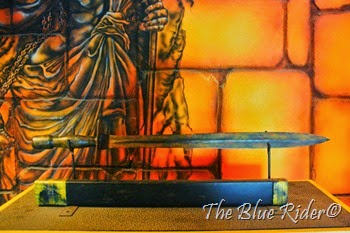
GREEK SWORD

It was introduced around 800-400 BCE, leaf-shaped blade effective for slashing and stabbing. The ancient Greeks regarded the sword as strictly a back-up weapon, one that would never replace their battle-proven reliance on the spear

 IMG_0614

CHARIOT

It was a fast, light, open, two-wheeled conveyance drawn by two or more horses  that were hitched side by side. Chariots were used for war and mobile archery platforms, as well as more peaceable pursuits such as hunting or racing for sport, and as chief vehicle of many ancient race, when speed of travel was denied rather than how much weight could be carried

IMG_0629

BRONZE SPEAR ARROWHEAD

It is a tip, usually sharpened, added to an arrow to make it more deadly or to fulfill some special purpose. The earliest arrowheads were made of stone and of organic materials; as human civilization progressed other materials were used like bronze

 IMG_0633

SCYTHIAN BRONZE INCENDIARY ARROWHEADS

The Scythians were masters of both horse and archery deadly with their small compound bows firing arrows form horseback tipped with arrowheads. The small profile of this arrowhead made it highly accurate when fired from a moving horse as it was not as susceptible to crosswinds compared to broader-shaped projectiles

IMG_0624

ANCIENT OIL LAMPS

It is used in ancient Greece for about 300 BCE to 200 CE. The earliest Greek lamps were wheel made. It is used for rituals and ceremonies. It is a symbol of connection to sacredness
IMG_0626

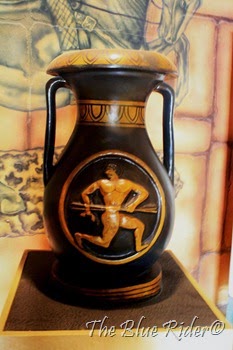
ANCIENT GREEK POTTERY

Pottery was important to the ancient Greeks for storage. Everything from wheat to wine was stored in pottery. Pottery was made by shaping clay on a wheel, decorating  the pot, and then heating the clay in a kiln. In early Greece, (1000 to 700 BC), pots were decorated with geometric designs
 IMG_0635

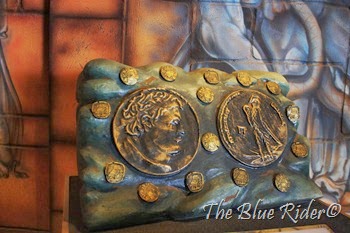
ANCIENT GREEK COINS

The Ancient Greeks were among the first people in the world to use coinage system starting in the 7th century BCE. The central denomination of this coinage system was the drachm, meaning "a handful"


Greek mythology consists of stories belonging to the ancient Greeks concerning their gods and heroes, the nature of the world and the origins and significance of their religious practices. The Greeks invented athletic contests and held them in honor of their gods. They also started the famous Olympic games which has been tested through times.

IMG_0638 

WRESTLING

It is a from of combat sport involving grappling type techniques such as clinch fighting, throws and takedowns, joint locks, pins and other grappling holds. A wrestling bout is a physical competition, between two (occasionally more) competitors or sparring partners, who attempt to gain and maintain a superior position. There are wide range of styles with varying rules with both traditional historic and modern styles. Wrestling techniques have been incorporated into other martial arts as well as military hand-to-hand combat systems.
IMG_0643

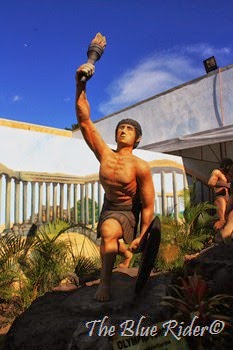
OLYMPIC TORCH

The Olympic flame is a symbol of the Olympic Games. Commemorating the theft of fire from the Greek god Zeus by Prometheus, its origins lie in ancient Greece, where a fire was kept burning throughout the celebration of the ancient Olympics.

 IMG_0645

DISCUS

The Diskobolus of Myron, the Discus thrower is depicted about to release his throw, is a Greek sculpture that was completed towards the end of the Severe period, circa 460-450 BCE
IMG_0658 

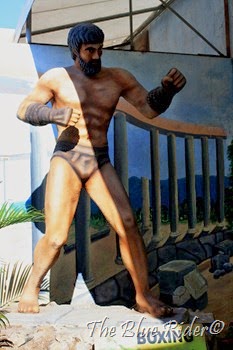
BOXING

It is a combat sport in which two people engage in a contest of strength, speed, reflexes, endurance, and will by throwing punches with gloved hands against another opponent. The birth hour of boxing as a sport started with ancient Greeks as an Olympic game.

Greek mythology consists of stories belonging to the ancient Greeks concerning their gods and heroes, the nature of the world and the origins and significance of their religious practices.

IMG_0647

POSEIDON

He is the great Olympian god of the sea, rivers, flood and drought, earthquakes, and horses. He was depicted as a mature man of study build with a dark beard and holding a trident.
 IMG_0649

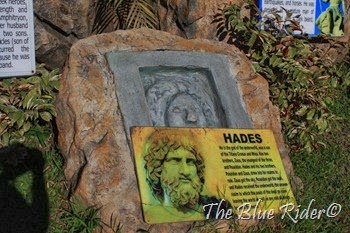
HADES

He is the god of the underworld, was a son of the Titans Cronus and Rhea. Has two brothers, Zeus, the youngest of the three and Poseidon. Hades and his two brothers, Poseidon and Zeus, drew lots for realms to rule. Zeus got the sky, Poseidon got the seas and Hades received the underworld, the unseen realm to which the souls of the dead go upon leaving the world as well as any and all things beneath the earth

 IMG_0650

HERCULES

He is the most popular of all Greek heroes, famous for extraordinary strength and courage. Alcmene, wife of Amphitryon, made love to both Zeus and her husband on the same night and bore two sons. Hercules (son of Zeus) and Iphilicles (son of Amphitryon). Hercules incurred the everlasting wrath of Hera because he was the child of her unfaithful husband

 IMG_0653

APHRODITE

She was the great Olympian goddess of beauty , love, pleasure and procreation. She was depicted as a beautiful woman usually accompanied by the winged Eros (Love)

IMG_0655

HERMES

He is a great Olympian God of animal husbandry, roads, travel, hospitality, heralds, diplomacy, trade, thievery, language, writing, persuasion, cunning wiles, athletic contest, gymnasiums, astronomy, and astrology. He was also the personal agent and herald of Zeus,m the king of the gods

These are just  portion of what Greece have contributed to the world and have influenced our modern world in many ways. Most of the infrastructures nowadays are still designed with tradition in mind. The sport stadiums built in Greece for their Olympics are much like our own present day stadiums. Also, we have incorporated statues on our modern architectures.

Aside from that, the Greeks valued human strength and performance. They are the inventors of the Olympics. More than human strength, competition was valued, which included not only a demonstration of human strength but a demonstration of human against sport.

Fascinating Egyptian Culture and Legacies

This country boasts wonders and extraordinary architectural creations. Here are some of the things I rediscovered about Egypt
IMG_0562
Block Statue of Nedjem
Nedjem held the office of "god's father" in the mortuary temple of King Merneptah during the reign of Remesses III. Nedjem dedicated this statue in the Eleventh Dynasty temple of Mentuhotpe II at Deir el Bahri so that he might partake of the offerings made to the gods worshipped there. It was called Block Status because of the seated position of this sculptureIMG_0565
Scribes
Scribes and priests were only taught how to read and write in temple courtyards. They memorized hieroglyphic symbols and kept records. Being one was often inherited and passed from generation to generation. A scribe was exempted from the heavy manual labor.
IMG_0567
King Tut
Tutankhamun, or better know as King Tut, is an 18th dynasty pharaoh (1332-1323 BCE) who inherited the throne at a young age of 10.  His reign was short-lived. He died at the age of 18. What caused King Tut's death has been the subject of considerable debate until now
IMG_0570
Egyptian Frog Goddess Heket
The goddess Heket, who was represented in the form of an Egyptian frog, was worshipped in the town of Hew-Wer. She is believed to be assisting in child births. Amulets and scarabs worn by women to protect them during childbirth often bear the image of the Frog Goddess    IMG_0572
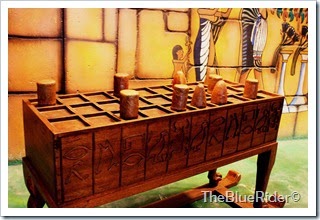
Senet
Known as the board games, this object was very common in ancient Egypt and people from all levels of society played them. However, the rules  explaining how to play these games did not survive, but experts have made some educated guesses on how these games were played
IMG_0574
Queen Ankhnes-meryre and her Son Pepy
Pepy, who became king at the age of six, had one of the longest reigns in the world history. During his childhood, his mother, Queen Ankhnes-meryre, acted as his regent, and she appears to be the primary subject of this statueIMG_0577
Egyptian Jackal
The Egyptian Jackal was sacred by the ancient Egyptians. One of their main and most important gods beheld the head of a jackal, Anubis, the god of the underworld. He was also the god who oversaw the process of embalming. With the head of a black jackal, Anubis can come off looking a little frightening to those who do not understand his powers  IMG_0580
Nefertiti Bust
A painted limestone bust of Nefertiti, the Great Royal Wife of the Egyptian Pharaoh Akhenaten. She has become one of the most famous women of the ancient world, and an icon of feminine beauty. The work is believed to have been crafted by the sculptor Thutmose. It was discovered in 1912 
IMG_0582
Kneeling Winged Isis
She was regarded as the symbolical mother of a King. Isis was also known as the "Eye of Ra" and was worshipped as the "Goddess of Magic" who had protected her son from danger, thus she would protect mortal children also. She was closely connected with Hathor whose physical attributes the cow's horns and sun-disk she adopted
IMG_0585
Cartouche
A structure or figure in ancient Egyptian hieroglyphics, often in the shape of an oval shield or oblong scroll, used as an architectural or graphic ornament or to bear a design or inscription. It is enclosed in characters expressing the names or epithets of divinity or royalty
IMG_0587
Egyptian Mummies
The methods of embalming, or treating the dead body, that the ancient Egyptians used is called mummification. Using special processes, the Egyptians removed all moisture from the body, leaving only a dried form that would not easily decay. It was important in their religion to preserve the dead body in as life-like a manner as possible. So successful were they that today we can view the mummified body of an Egyptian and have a good idea of what he or she looked like in life, 3000 years ago
IMG_0592
4 Colossi of Ramses II
The 4 towering colossi can be found in the entrance of the Temple of Re-Harakhte or also know as The Sun Temple of Ramses II. These giants are believed to have been protecting the sacred structure from the time it was built
IMG_0593
Egyptian Sphinx
It designates a type of statue joining a human head to the body of a lion which symbolizes sovereignty combing the strength of the lion with a human intelligence. It was viewed as benevolent, a guardian. The Sphinx was the embodiment of royal power often shown smiting the King's enemies, or the King himself being represented as a victorious Sphinx trampling of his foes
IMG_0596
Ancient Egyptian Pottery
Pottery came first before Pyramids. this is evident from the presence of older hieroglyphic writing with characters which have images of earthen vessels. Pictures of pottery vessels and small pieces of pottery have been found in tombs. It was made for functional reasons
IMG_0594
The Great Pyramid of Giza
It is the oldest and largest of the three pyramids in the Giza. It is the oldest of the Seven Wonders of the Ancient World, and the only one to remain largely intact. Egyptologists believe that the pyramid was built as a tomb for fourth dynasty Egyptian Pharaoh Khufu over a 10 to 20-year period concluding around 2560 BCE. It was the tallest man-made structure in the world for over 3,800 years        IMG_0588
The effect or remembrance of what Egypt accomplished at the very dawn of history has influence in every nation and every age. It is an important testimony to the power of the Egyptian mythos that so many works of the imagination, from films to books to paintings, have been inspired by it and the ancient culture continues to attract enthusiasts from around the world. The things i saw here may not be everything about Egypt but at least i get to see some of the remarkable creations and discoveries during ancient times. Who knows, i may be able to land in this place someday :)